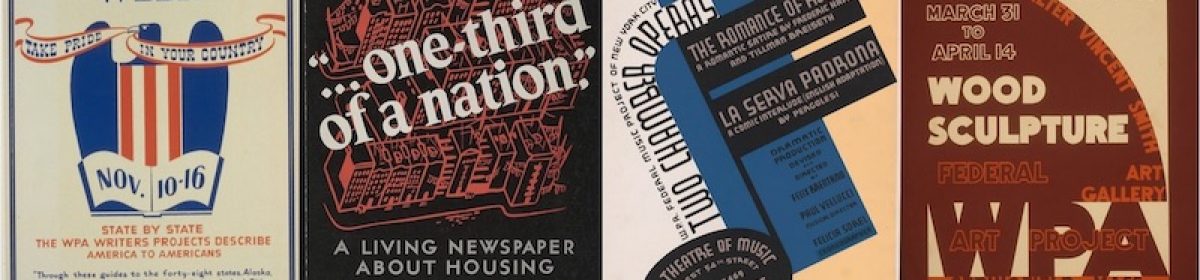
The image I selected is from the Work Projects Administration ( http://jessicadoeshistory.com/cnd/admin/items/show/167 ) and depicts a family, a father, mother and child all prepared for the work that is ahead. The father looks like he is holding some sort of tool for a factory job while the mother is holding a sort of mop depicting household work and the child is empty-handed but looks more than ready to work. I chose this image because I thought it was strong, inspiring, and true. Strong because it shows that there will be work that needs to be done, and only you can do that work. Inspiring because it encourages people to help others and if you can get your job done then you can help someone else (your wife) get their job done as well. And truthful because it is how the 1930’s work situation was arranged. The father usually worked in a factory while the mother stayed home, developing the child and fixing up the house. This reveals that almost every family in the 1930’s was in this gender roll arrangement. The answers to the historical questions I was seeking consisted of: “How can the government encourage families to get their work done when nothing is guaranteed?” This poster method helps us think more critically because it depicts an ideal situation, that may seem impossible, but with the help of the specifics on the posters and hard work, can be achieved for a better life. These methods helped me learn more about the poster because every little aspect of it had a description as for why it was there, how it helped people and in what way it helped them. http://jessicadoeshistory.com/cnd/exhibits/show/https—www-loc-gov-pictures-r The conclusions I took away from this are that one, a poster showing an ideal situation can motivate people to achieve that outcome; and two, everyone has a place on this planet, no matter what kind of work you are doing, there is always work that needs to be done.
Category: Uncategorized
Extra Credit
I believe Dickstein was right in his belief that Art creates a form of escapism, as well as allowing people to think in a more creative, less literal way that can stimulate growth and perspective in times of struggle. Dickstein stated that the “economic devastation of 2008 created more than just financial trouble, it is accompanied with psychological depression, feelings of low morale, feeling hopeless, and a terrifying sense that the future will bare only trouble.” These feelings cannot be fully accounted for or fixed with the government talking about the situation at hand. Times like these demand another form of encouragement to get the mental and economic state of being back from despair. Art, in any sense, has helped people grow, learn, and adapt to the constantly changing world we live in. In today’s time, we do not have any crisis regarding the stability of the economic market, but we do have major issues in other areas. For example, there are huge movements happening with the LGBTQ community and it continues to grow because the popular culture is becoming less judgmental and more open with how people feel and what people need to thrive. The movement really caught fire and began in 2015 when Bruce (Caitlyn) Jenner announced his transition from being a male to female. This sparked something all over the world but for the first couple years and still now mainly in the United States. People all over were now comfortable enough to announce their own truths, the thought that “if Bruce can do it on a global stage then I can do it in my own life” snowballed all over. Thus creating a new future where people can feel much more confident and aware of who they are without the fears of rejection. Another example I see in today’s society is in Comedy acts. Comedy is a great form of art; it creates a whole new perspective for situations. If we can turn a terrible situation into a “I mean come on, how did we let this happen, really?” kind of joke, we can accept it better and grow from it. With that being said, popular culture is not always following good patterns. The new movie ‘The Joker’ has stemmed a lot of talk about how people relate more with the Joker and identify as someone as lost as he is. The movie is said to depict a lot of real life situations and circumstances of unfair treatment. This is bad because the popular culture will follow with negative thoughts and actions to back up their fears. To answer the question simply, Dickstein is correct that people will seek another form of relief during bad times, but that reliance on escapism can create a sense of dependency that we NEED something other than reality to help us grow.
Blog Post #1: Wearing Gay History
This first week we talked about asking historical questions, using and analyzing primary sources, the Communist Party in America, and a lot of the cultural programs that were enacted during the Great Depression and the overall culture of the 1920’s. I’d really love to talk more about the impact the Red Scare had on the cultural attitudes of the twentieth century. Not just the political attitudes, although those are linked with culture.
This was actually a really cool exhibit for me to focus on for this post, as I consider myself to be queer. LGBT history is extremely important to me and there was one photo in the exhibit that really stood out to me. It was a photo of a camouflage army jacket with a pink triangle painted on the front and the back. During World War II gay men who were arrested and sent to concentration camps were identified by having pink triangles painted on their prison issued shirts. All of these photos are of pieces of clothing from very important events in LGBT history. There’s a jacket from The Gay Games in Sydney, a hat made for Team Los Angeles from the Gay Games in 2006, and the aforementioned jacket. The way this exhibit is set up is very interesting. It’s important to have exhibits like this available on the internet, it makes them more visible and more accessible to the general public. Anyone can see them anywhere- you don’t have to go to a museum to look at them. We can also see who the contributor was (if they were identified), what year it’s from, what collection it resides in, and the geographical location of either the item itself, or where the event it originated from was located. Part of scholarship is sharing your thoughts, your pieces, and your work, and creating a digital exhibit like this one provides easier access and a larger forum of discussion.
Blog Post 1
I have always enjoyed history and learning about history so I have a good basic understanding about the Great Depression, New Deal, World War l and ll, and other world events around that time. I am a big believer in the “those who do not learn from history are doomed to repeat it” saying so I actively try to know my history. This past week of class acted as a good refresher to this time time period while also providing some new aspects to the era that I did not know or think about. The introduction of the older technology and its implementation and importance specifically, are topics that I never gave much thought to when learning about this time period. Things such as the radiophone and the early creation of the silent disco/dance parties are things that I have only recently learned about and I hope to learn more about such things this semester. The near failure of the technology mogul, IBM, is something that I did not know about as well. I am excited to learn about the digital past and the history of digital technology growth and importance as it is not something that I would normally try to educate myself on. I think it will be a great semester to expand my historical knowledge and awareness.
I was assigned to analyze project #38, the photogrammar website, using Miriam Posner’s framework. The Photogrammar website is a collection of over 170,000 pictures from the time period we are discussing in class, 1930’s and 40’s. It is unique in that it geographically categorizes all of its photographs using a map of the United States. This makes the website very organized and easily accessible. The website also posts its main sources in big letters on the main page. Photogrammar allows its users to visually see the highs and lows of the time period and see how specifically how certain areas of the country were impacted differently. The accessibility of this photograph database, being web-based, is extremely useful and enlightening as it provides a more in depth look into the era than textbooks and literature can provide.
Miriam, Posner. (2014, February 1). How did they make that?.Retrieved from http://miriamposner.com/blog/how-did-they-make-that/
Dauterive, Jessica. What is Digital Humanities? Retrieved from https://slides.com/jdauteri/what-is-digital-humanities#/1.
Blog post #1
I have been familiar with aspects of the 1930’s to the since highschool. I was taught about the stock market crash which brought about the Great Depression. Many people during this time were unemployed, broke and living in hoovervilles.We saw a picture in class where a man was selling his car for $100.00 which really makes you realize that these individuals were struggling to make it through. What I learned and found interesting was the technology that was emerging during this time period. In class last week we learned that there was a shift happening from computing with emphasis on humanities to humanity that are in digital form. One of the inventions during this time was the punch card which became the official computing device for the New Deal.
The project that I was assigned to analyze was the Archive for Virtual Harlem by Jessica Johnston. Johnston researched and found influential artists, poets and musicians that were apart of the Harlem renaissance. The Harlem Renaissance was a time where “African Americans wanted to express themselves freely” and so there was a “ cultural, social and artistic explosion”. The main page of the website explains Johnstons idea that by making a virtual Harlem where individuals can experience sounds and art through interactive modules, one can understand more of the culture than if they were reading about it in a book. On the left side of the website there are different links that are clumped together with artists, poets and musicians. When clicking them they will take you through the individuals bio, some of their work and their influence in Harlem. The way this is set up makes the process easy to explore. There is also a bibliography at the end with tons of credible sources which makes this archive that much more reliable. The way this archive is set up makes one understand just how influential and important the Harlem Renaissance was. The talent that was brought up and expressed because of this time period really paved the way for the future of African American culture in the United States.
Johnstone, Jessica.An Archive for Virtual Harlem. Retrieved from http://scalar.usc.edu/works/harlem-renaissance/title-page
Miriam, Posner. (2014, February 1). How did they make that?.Retrieved from http://miriamposner.com/blog/how-did-they-make-that/
blog post 1
The 1930’s are a phenomenal place to begin to pick apart different sectors of the economy, entertainment, and environment. The 1930’s offered the introduction of new technologies such as IBM being rescued by the social security act and creating an official computing device. The Great Depression is my favorite time period, although it is a harsh moment in history, it has been an example for the prevention of similar acts to occur. Therefore, my overall understanding of this course is to touch bases on how different technology has affected history and ways we can use technology to examine these different sectors. Miriam Posner offers great methods to examine a project and understand how to dissect it in a logical way. Although I found it slightly confusing trying to pick apart the overall key factors of the sources, I hope with time I am also able to look at a source and recognize the key elements of structure, data analysis and format.
The source I received was The making of a Broadside Ballad which explains the in depth creation of a Broadside Ballad as well as its functionality. The website offers a listed order on how it is made such as paper making, wood cutting, writing verses/ looking for verses, performance, and an overall reflection on how the process affected their perception. The steps are explained through instructional videos, with the exception of the introduction and reflection essays at the end. My overall understanding for the making of the Ballads, was to gain emotional understanding of the process and engage in critical thinking to understand the history of the Ballads. The making of a Broadside ballad, taught me what a ballad is, how it is made, and how the process of making it altered perspectives by comparison to the ones in history. I was heavily impressed with the time dedicated into the individual construction of a ballad. Craftsmanship appeared to be a delicate composed act in creating a perfect Ballad. Overall, the source offered great informational tutorials on how to create these pieces.
“Syllabus and Course Info.” Hist 390 The Digital Past:A Cultural New Deal, jessicadoeshistory.com/cnd/exhibits/show/fall-2019/syllabus.
“the making of A Broadside Ballad.” The EMC Imprint | Publishing Multi-Media Literary and Cultural Studies, 1500-1800, press.emcimprint.english.ucsb.edu/the-making-of-a-broadside-ballad/index.
History 390: The Digital Past – Assignment No. 1
Part 1
Before classes began this August, I got together with a number of my friends, and we discussed the courses that we would were taking this semester. When I spoke about this class, a good friend of mine laughed and jeeringly remarked that come the end of the semester I would walk away with only useless information on the history of the punch card and a few vague facts about the life of Alan Turing. However, after attending last week’s sessions, I learned that my cynical friend could not have been farther from the truth. While I cannot argue that its start may have been quite dry, digital history tells the stories of countless imaginative and innovative people, who challenged the very nature of information as it had come to be understood by everyone prior to them. Author Jorge Luis Borges envisioned stories that extended beyond the pages of books and empowered readers to become an actors in their own stories; and Ted Nelson, possibly inspired by Borges’ vision of a new, freer style of information, went on to develop Project Xanadu, a program that would allow readers the ability to navigate electronic documents along paths they themselves had chosen. Although they do not appear shocking to someone living in the 21st century, when placed in the context of our informational past, these ideas were revolutionary and continue to influence the ways in which we approach the digital world. While I’m unsure as to whether or not these topics will be covered in the course, I’m hoping to take a closer look at Borges and Nelson’s philosophies as well as the long-term transition from using information technology as a tool to organize people (i.e. punch cards) towards its use today as a cross-cultural media and information sharing platform.
Part 2
The digital project assigned to me is entitled, “The Lost Museum”. It digitally reconstructs Barnum’s American Museum through a virtual exhibit that incorporates 3D imaging and multimedia narratives in the form of hyperlinks scattered throughout the museum’s interior and digital imaging. The sources used in this project include posters, documents, and digital reconstructions of artifacts found within the museum prior to its eventual collapse. As mentioned earlier, the sources used in this project were processed as historical sites or digital images. These processed sources are scattered throughout a digital reconstruction of the museum’s interior, and online visitors may explore them as they see fit. Although it does an excellent job of reconstructing the museum, the project makes it difficult for a visitor to explore its contents. Perhaps the use of virtual reality equipment and software would solve this problem. However, placing this criticism aside, the project captivates its audience and provides them with a true 19th century museum experience, one unimaginable without the use of digital technology.
Blog Post #1
I have slight knowledge of the 1930s through the many history classes I have sat through in High School. Class discussions about the Great Depression, and the New Deal only strengthened my understanding about these topics. Class also helped me learn more effects these topics had on the American population, rather than the World as a whole. Though the information technology/ digital humanities part of the lectures were new topics to me. I learned about the production of the first computer, and the introduction of the first computer web browser. I am very interested in using many of these online tools to research more about the digital past, and learn more about technology.I hope I can help expand my understanding about America’s past and learn about how “history might be repeating itself.”
I have been assigned to the “Seattle Civil Rights and Labor History Project,” written by faculty, community groups, undergraduate and graduate students at the University of Washington. The idea of this project is to bring attention to Civil Rights in Seattle, also to the labor movement. Throughout the 1900’s civil and labor Unions and Radical organizations have shown proof of giving critical support to racial justice. This project uses a variety of different tools to relay information, such as oral histories, film & slideshows, and research reports. The data that was collected was well presented, it included extensive well written research. Each Historical Essay cited within this project is about interesting issues and incidents. Some topics include immigration rights, Native American land rights, segregation, women’s rights, etc. Each Historical Essay is fully equipped with photos, and clippings of Newspapers. The Film & Slideshow tab of this site has proven to be incredibly useful. Being able to watch and listen to individuals who have personally experienced these conflicts helped solidify my understanding of the issues. Also cited on this site are different Civil Rights Organizations that were present in Seattle at the time, and the efforts they extorted to help support this movement. Unfortunately, some of the links listed on the site were expired, or not found. So I was not able to fully explore this exhibit.
Sites
“Seattle Civil Rights and Labor History Project.” Seattle Civil Rights and Labor History Project Seattle Civil Rights and Labor History Project, 2004, http://depts.washington.edu/civilr/.
Blog Post #1 – Project 33
I really enjoyed our brief dive into how we define technology. I thought it was really interesting to look at how our modern digital tools, such as hard drive folders or ebooks, can be traced back to concrete versions, and their entire history. I think that it is easy to forget the histories of the technology and objects that we use every day. I’m hope to learn more about the history objects in this class, and to redefine my understanding of technology.
I felt like Project #33, which discusses while streamlined and visually appealing, was not terribly engaging. The writing in the front summary/abstract paragraph was written in opaque in a manner that lacked appeal to viewers outside of the historical field who might not be accustomed to reading denser texts, and yet the text in the topics page was almost oversimplified. I think that a stronger introduction and images beyond graphs and charts be utilized to build interest and humanize the hard statistical data. Furthermore, the front webpage appears at first to be the introduction page, but only after reading through the entire study did I realize that a lengthy and detailed introduction existed separately. The webpage would benefit from better organization. I do, however, think that this study was very interesting—one point in particular that stood out to me was the fact that even though fugitive slave advertisements in Richmond rose during the Civil War, hiring and wanted advertisements remained at a fairly separate level. This indicates that even as the war continued and more and more slaves managed to escape to the north, people were still unwilling to hire replacements, rather choosing to continue endorsing the institution of slavery.
Nelson, Robert K. “Mining the Dispatch.” Mining the Dispatch. The University of Richmond. Accessed September 2, 2019.
Blog Post #1
I already knew a bit about the 1930’s because I took AP US History in high school so I remember a lot of the new deal and of the great depression. However in class we never went over the impact of specific programs because to go over every single one would take too much time but we went over how the programs help the United States overall. I’m very interested in seeing how promoting the arts will help stimulate not only the economy but also enrich the lives of Americans through these difficult times. I haven’t worked a lot in digital history although I am very invested in learning history so I’ve researched different periods in history for specific groups of people before. I’m nervous that I’ll have difficulty in certain areas like trying to find information on specific ideas or groups because I’m not sure how much was recorded in that time period. Overall I’m excited to be in this class and I think it will be engaging while also pushing the boundaries of what I’ve thought before.
I was assigned the project “Musical Passages” which plays the first transcribed African music in the Caribbian. This music was written down in 1707 by Hans Sloane who wrote a book called “Voyage to the Islands of Madera, Barbados, Nieves, S. Christophers, and Jamaica” and the music tells the stories of slaves. The first thing you hear when you open up the page is the ocean, and then suddenly different kinds of music play from different areas, but all with the sound of the ocean in the background so you feel as though you’re listening on a boat or by the sea. At the bottom it explains what Sloane wrote about, the different types of African music in the Caribbian, and it also breaks down each piece that they play while you’re listening to them. This project was created to share the story and music of the slaves whose stories are often forgotten and spoken over. Musical Passages gives the listener a sense that they’ve gone back in time and if you close your eyes, you’re practically transported. It is interactive as well because the listener can click on the music they want to hear. The set up makes you slow down and really interact with a different time period in a way we’re often not able to do.
Works Cited:
